Se afișează postările cu eticheta bani. Afișați toate postările

duminică, 14 august 2011

Some World's Currencies

Euro
The euro is the result of the most significant monetary reform in Europe since the Roman Empire. Read the latest on how the European Union is handling the debt crisis.
Yen
The yen is one of the most frequently traded world currencies (where does it rank?). Get the latest news on what effects a major disaster has had on its value.
Peso
The most-traded currency in Latin America, the peso also served as the model for several other currencies. It recently made news for its gains.
Won
The won has been in use for thousands of years, and could be positively affected if a much-talked-about agreement goes through.
Dinar
Before the dinar, this country used the rupee. Recent reports show that one industry still calls the political and economic shots.
Rial
The rial was first introduced in 1798 as a coin, and the country that uses it recently celebrated this anniversary.
Rupee
The word "rupee" was derived from this. The country where it's used is experiencing record-high rates on a hot commodity.
Pound
The home of the pound took a pass on the euro to retain its currency. The fourth-most-traded currency in the world has this distinction, and a special coin features a new princess.
Shekel
The shekel has been around for thousands of years. The country that uses it recently unveiled a new way for tourists to go back in time as well.
Franc
The legal tender of this country used to be traded here as well. What will happen to the economy if the ban they are discussing goes through?
Rand
This official currency takes its name from the ridge this city is built on. The country will be hosting a major event in 2012.
Shilling
The shilling has been legal tender since 1962, and its home country has been in the news recently because of incidents involving these outlaws.
Lira
The lira usually features an image of this man. The country recently began trading at one of its borders.
Naira
The legal tender of this country is being spent more and more on this growing industry, a welcome distraction from recent events.
Dollar
Not the "e pluribus unum" version, this country's dollar has been around since 1858. The nation also hosted a big event recently.
Ruble
This legal tender's name allegedly came from this verb. The country that uses this currency is trying to find ways to regulate a major information source.

Some World's Cooles Money

"American money," in the words of Talking Heads frontman David Byrne, "is the ugliest money in the world." Every note is the same color and size, making for a particularly monotonous currency. Here are some more imaginative notes from around the world.
Australia was the first to make its legal tender out of plastic polymers, which last four times as long as conventional notes and provide much greater security against counterfeiting. Yet they are still recyclable when retired from circulation. A transparent window and a raised printing process called intaglio allow blind people to feel the difference among the denominations.

The U.S. dollar is widely accepted as Cambodia’s currency, but folks use riels for amounts smaller than $1. With its depiction of Angkor Wat on the front and the Kizuna Bridge over the Mekong (signifying friendship with Japan) on the back, the 500-riel note is practically a postcard. And since the exchange rate (5,000 riels to one U.S. dollar) makes this note worth about 10 cents, it’s cheaper than buying one.
Want to know which animals constitute The Big Five? Just check your South African currency, which has likenesses of the rhino, African elephant, lion, Cape buffalo and leopard. Some South Africans even refer to notes by the animal, so “a buffalo” means 100 rand. A rash of counterfeit 200-rand notes (aka leopards) before the World Cup in 2010 caused many merchants to stop accepting them.
Just one look at this bill from French Polynesia in the South Pacific and all your cares seem to melt away. No stuffy pictures of conquering war heroes here. These notes feature pretty women with flowers in their hair, traditional thatched-roof huts perfect for afternoon naps, unspoiled corals, tropical fish in a rainbow of colors and denominations, and palm trees swaying in the breeze.
Remember Disney Dollars, those commemorative bills you could purchase with real dollars but then never redeem after leaving the theme park? Salt Spring Island, part of the Gulf Islands of British Columbia, took the idea a step further in 2001, issuing these beautiful notes that celebrate the community. Many island merchants, including banks and the post office, offer a discount for using the local currency.
Encouraged by the success of Salt Spring dollars, the tiny Vancouver Island community of Chemainus (population 3,900) started issuing its own currency in 2010. It proved unimaginably popular: Collectors quickly snapped up all the $100 notes, and neighboring towns started accepting the bills. Emily Carr, whose paintings are synonymous with Chemainus’ First Nations communities and their respect for the natural surroundings, graces each bill.
A charity known as Fifth Pillar started printing these bills in 2010 to protest widespread corruption in India. Like all of the country’s legal tender, the zero-rupee bill features a likeness of Mahatma Gandhi. But it also declares “I promise to neither accept nor give bribe.” Be careful who you give these to; you might get a fat lip as your change.
Hyperinflation caused Zimbabwe to tack zeroes onto its notes repeatedly, and still people had to carry bushels of bills to complete simple purchases. Hard currencies like the South African rand and the U.S. dollar were legalized for use in Zimbabwe in 2009, rendering Zimbabwean dollars, even trillions of them, worthless. Except, that is, on eBay, where they’re a hot commodity among collectors.
Not only are Swiss francs one of the world’s most stable currencies, they’re also one of the few that are meant to be viewed vertically. And where most currencies would feature a dead president, Switzerland's franc instead celebrates cultural icons, all of whom made their marks in the 20th century, from the architect Le Corbusier to historian Jacob Burckhardt.
Eritrea has only been an independent African nation for two decades, so its currency eschews former heads of state in favor of typical Eritreans of today. And each note features not just one, but three figures from the current era, usually smiling young women festooned with jewels.
Most of Colombia’s currency is unremarkable, but this latest note, first issued in 2000, is an exception, even though it depicts a long-dead white man on its obverse. The likeness of author Jorge Isaacs is rakishly rotated vertically, and a paragraph of his 1867 novel, La Maria, overlays an image of El Paraiso, the hacienda where much of the book takes place.
Sir Edmund Hillary did something even more rare than conquer Mount Everest. In 1992, he became one of the few non-heads of state to appear on a nation’s currency while still alive. (The U.S. has a law forbidding living people from appearing on its bills.) Hillary, who died in 2008, agreed to be depicted only if New Zealand’s highest peak, Aoraki/Mount Cook, were the backdrop rather than Everest.

Antarctica isn’t a country, so these notes aren’t legal tender. But they’re accepted like cash at the few places on the continent where money is needed. The funds raised from selling these colorful notes as collectors' items goes to fund research projects like the one featured on the $100 bill: investigating the hole in the ozone layer.
Source

joi, 28 iulie 2011

Top 5 Biggest Hyperinflations in World History

In economics, hyperinflation is inflation that is very high or "out of control". While the real values of the specific economic items generally stay the same in terms of relatively stable foreign currencies, in hyperinflationary conditions the general price level within a specific economy increases rapidly as the functional or internal currency, as opposed to a foreign currency, loses its real value very quickly, normally at an accelerating rate. Definitions used vary from the International Accounting Standards Board's a cumulative inflation rate over three years approaching 100% (26% per annum compounded for three years in a row) to Cagan's (1956) "inflation exceeding 50% a month." As a rule of thumb, normal monthly and annual low inflation and deflation are reported per month, while under hyperinflation the general price level could rise by 5 or 10% or even much more every day.

A vicious circle is created in which more and more inflation is created with each iteration of the ever increasing money printing cycle.

Hyperinflation becomes visible when there is an unchecked increase in the money supply (see hyperinflation in Zimbabwe) usually accompanied by a widespread unwillingness on the part of the local population to hold the hyperinflationary money for more than the time needed to trade it for something non-monetary to avoid further loss of real value. Hyperinflation is often associated with wars (or their aftermath), currency meltdowns like in Zimbabwe, and political or social upheavals, plus an aggressive bidding against the money on currency exchanges.

These are the five biggest hyperinflations in world history:

1. Hungary (July 1946)

The 100 million b.-pengő note The 100 million b.-pengő note (photo)

Hungary went through the worst inflation ever recorded between the end of 1945 and July 1946. In 1944, the highest denomination was 1,000 pengő. By the end of 1945, it was 10,000,000 pengő. The highest denomination in mid-1946 was 100,000,000,000,000,000,000 pengő. A special currency the adópengő - or tax pengő - was created for tax and postal payments. The value of the adópengő was adjusted each day, by radio announcement. On 1 January 1946 one adópengő equaled one pengő. By late July, one adópengő equaled 2,000,000,000,000,000,000,000 or 2×10²¹ pengő. When the pengő was replaced in August 1946 by the forint, the total value of all Hungarian banknotes in circulation amounted to one-thousandth of one US dollar. It is the most severe known incident of inflation recorded, peaking at 1.3 × 10¹⁶ percent per month (prices double every 15 hours). The overall impact of hyperinflation: On 18 August 1946, 400,000,000,000,000,000,000,000,000,000 or 4×1029 (four hundred octillion (short scale)) pengő became 1 forint.

  • One source states that this hyperinflation was purposely started by trained Russian Marxists in order to destroy the Hungarian middle and upper classes. The 1946 currency reform changed the currency to the forint.
  • Earlier, between 1922 and 1924, inflation in Hungary had reached 98% per month.

2. Zimbabwe (November 2008)

Zimbabwe $100 trillion 2009 Obverse This is an image of the $100 trillion banknote of Zimbabwe.

Hyperinflation in Zimbabwe began in the early 2000s, shortly after Zimbabwe's confiscation of white-owned farmland and its repudiation of debts to the International Monetary Fund, and persisted through to 2009. Figures from November 2008 estimated Zimbabwe's annual inflation rate at 89.7 sextillion (1021) percent. By December 2008, annual inflation was estimated at 6.5 quindecillion novemdecillion percent (6.5 x 10108%, the equivalent of 6 quinquatrigintillion 500 quattuortrigintillion percent, or 65 followed by 107 zeros – 65 million googol percent). In April 2009, Zimbabwe abandoned printing of the Zimbabwean dollar, and the South African rand and US dollar became the standard currencies for exchange. As of 2011 the currency has not been reintroduced yet.

3. Yugoslavia (January 1994)

500,000,000,000 Yugoslav dinar banknote 500,000,000,000 Yugoslav dinar banknote

Yugoslavia went through a period of hyperinflation and subsequent currency reforms from 1989-1994. The highest denomination in 1988 was 50,000 dinars. By 1989 it was 2,000,000 dinars. In the 1990 currency reform, 1 new dinar was exchanged for 10,000 old dinars. In the 1992 currency reform, 1 new dinar was exchanged for 10 old dinars. The highest denomination in 1992 was 50,000 dinars. By 1993, it was 10,000,000,000 dinars. In the 1993 currency reform, 1 new dinar was exchanged for 1,000,000 old dinars. However, before the year was over, the highest denomination was 500,000,000,000 dinars. In the 1994 currency reform, 1 new dinar was exchanged for 1,000,000,000 old dinars. In another currency reform a month later, 1 novi dinar was exchanged for 13 million dinars (1 novi dinar = 1 German mark at the time of exchange). The overall impact of hyperinflation: 1 novi dinar = 1 × 1027~1.3 × 1027 pre 1990 dinars. Yugoslavia's rate of inflation hit 5 × 10¹⁵ percent cumulative inflation over the time period 1 October 1993 and 24 January 1994.

4. Germany (October 1923)

50 million mark A 50 million mark bill from the days of the German depression. (photo)

Germany went through its worst inflation in 1923. In 1922, the highest denomination was 50,000 Mark. By 1923, the highest denomination was 100,000,000,000,000 Mark. In December 1923 the exchange rate was 4,200,000,000,000 Marks to 1 US dollar. In 1923, the rate of inflation hit 3.25 × 10⁶ percent per month (prices double every two days). Beginning on 20 November 1923, 1,000,000,000,000 old Marks were exchanged for 1 Rentenmark so that 4.2 Rentenmarks were worth 1 US dollar, exactly the same rate the Mark had in 1914.

5. Greece (October 1944)

10,000,000,000 Drachmai 10,000,000,000 Drachmai

Greece went through its worst inflation in 1944. In 1942, the highest denomination was 50,000 drachmai. By 1944, the highest denomination was 100,000,000,000,000 drachmai. In the 1944 currency reform, 1 new drachma was exchanged for 50,000,000,000 drachmai. Another currency reform in 1953 replaced the drachma at an exchange rate of 1 new drachma = 1,000 old drachmai. The overall impact of hyperinflation: 1 (1953) drachma = 50,000,000,000,000 pre 1944 drachmai. The Greek monthly inflation rate reached 8.5 billion percent in October 1944.

Source: Wikipedia.org

miercuri, 27 iulie 2011

TOP 10 Hottest Women of Business

For many, the word “businessperson” connotes men in white shirts and stranglehold neckties. That stereotype may have held true in the 1950s, but since then, the appearance factor of the business world has evolved substantially.

Take women. Hot women have always populated the business world in some shape or form. We tasked ourselves with compiling a list of the hottest businesswomen we could think of, for your viewing pleasure. These women are accomplished both in the business and the looks departments. Get acquainted with these hotties, outside of the cube–and outside of the pantsuit.

10. Marissa Mayer
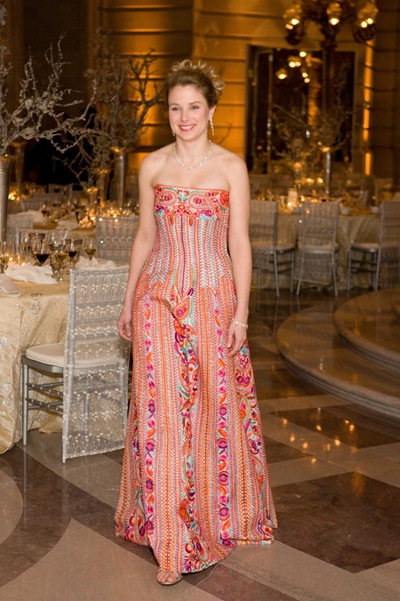
Marissa Mayer (in Naeem Khan & jewelry by Graff)

Business Accomplishments: High-level management at Google.

Marissa Mayer was one of the first 20 employees at Google, so she has obviously been influential in steering the company towards its massive success and market share dominance. She currently serves as Google’s VP of Search Product and User Experience and de facto spokesperson. Her job is to verify whether Google products are ready for user release. Early on, Melissa used to date Google co-founder Larry Page, but has since moved on to other pastures. She is free for the looking for everyone.

9. Arianna Huffington
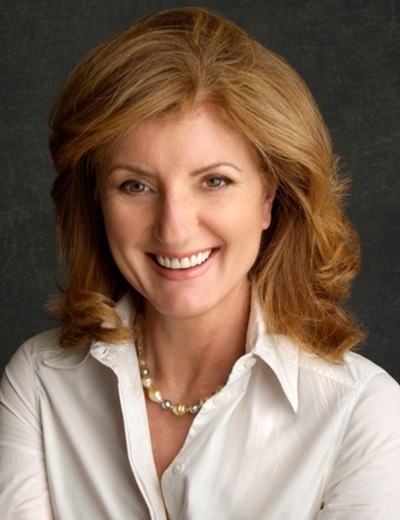
Arianna Huffington

Business Accomplishments: Founder of one of the most successful and influential websites ever.

The dynamic founder of the Huffington Post also boasts well-preserved good looks. She has quite the journalistic background, ranging from a panelist position on the BBC radio to co-hosting an Air America show. She used to be a vehement anti-Clintonian conservative; the HuffPo shows she has swung the other direction. Her hot qualities, meanwhile, stayed the same.

8. Rachel Ray

Rachel Ray

Business Accomplishments: Her brand. She can basically sell anything she wants at this point.

In fewer than seven years, Rachael Ray, 39, has radically changed the way America cooks dinner. Her perky-girl-next-door swagger, her catchphrases for techniques and her dinner ideology of simpler, less expensive and just in time have sold billions of books and placed her at the top of the talent love heap at the Food Network, which has changed its focus from information exchange to helpful encouragement.

As the author of the “30 Minute Meals” series and show of the same name, she parlayed her Food Network Success into a daytime talk show carried and blessed by Oprah herself and Harpo Productions. She also launched “Everyday with Rachel Ray” a lifestyle and Entertainment magazine focused on home and entertaining.

Recently she just launched a line of Dog Food called “Nutrish” cashing in on her quirky phrases that have endeared her to many.

7. Gina Bianchini

Gina Bianchini

Business Accomplishments: CEO of wildly successful Ning. Founder of Harmonic Communications and benefactor of its liquidation event.

Bianchini co-founded Ning, a customizable social networking platform, with Netscape founder Marc Andreessen in 2004. This Stanford MBA and former Goldman Sachs financial analyst has guided Ning’s unique platform, where users build their own features, to astonishing rates of success, from unnecessary $60 million VC rounds to phenomenal growth rates. She is also really hot.

6. Queen Rania of Jordan

Queen Rania of Jordan

Business Accomplishments: Board member of the World Economic Forum, founded the Queen Rania Center for Entrepreneurship

Queen Rania is a major advocate of women’s rights around the world, including the Middle East. She was ranked 81st in the Forbes 2005 100 most powerful women of the world list. She is a major philanthropist and supporter of the micro-fund movement.

5. Alexis Glick

Alexis Glick

Business Accomplishments: Vice President of Fox Business News & former Executive Director at Morgan Stanley

Alexis Glick is the hot on-air personality that (we think) is the main reason that millions of men watch Fox Business Network each week. She is hugely influential in the business world because of her control over strategy and programming decisions at Fox Business Network.

4. Tyra Banks

Tyra Banks

Business Accomplishments: Her brand and influence through her show. TV & film production. Product lines. Real estate development.

A successful model most of her life and an young female African-American role model to many, Tyra Banks could have stopped there, but has only risen since.

Starting in May 2003 her creation-America’s Next Top Model started modestly and has grown into a worldwide hit and is embarking upon its 10th cycle. The most recent edition was the network’s top-rated series, averaging 5.2 million viewers weekly. And The Tyra Banks Show — a broad mix of women’s issues and frothy fare — is now a talk-show force to be reckoned with: 4.3 million adult female viewers tuned in weekly this past November sweeps, and, with a median age of 40, Tyra has the youngest talk-show audience in daytime. (Oprah’s median age is 55.) Now the 34-year-old has a broader goal in mind: world domination. (Yes, seriously.) With a recent multimillion-dollar TV-and-film-production deal through Warner Bros. Entertainment, along with retail and real estate projects in development, Banks is poised to become the most influential woman in television since the almighty O herself.

3. Heidi Klum

Heidi Klum

Business Accomplishments: Executive Producer, Project Runway. Clothing and accessory lines. Brand sponsorships.

From fashion runways to Project Runway, Heidi Klum’s goldilocks and 1,000 watt smile has lit up magazine covers, stages and screens from here to Milan since 1992. Bronze and toned, her body splashed the cover of Sports Illustrated and earned her the coveted “Angel” position with Victoria’s Secret. She has appeared in several television shows and movies, which led her to pitch and secure the phenomenally popular and only reality-show winner of the Peabody Award “Project Runway” on Bravo as Host, Judge and Executive Producer. Behind her playful lips and cutesy German accent lies the mind of brilliant businesswoman dedicated to expanding her empire; which in 2008 Forbes estimated at 14 million a year and growing, placing her 2nd on the Top Model list. With her own clothing and accessories line coming in 2009, spokesperson deals with Jordache and VW and her countless appearances on film and television, there are a lot chances to salivate over Heidi for a long time.

2. Beyonce Knowles

Beverly Hilton

Business Accomplishments: Entertainment empire, endorsement deals, fashion lines.

After ditching Destiny’s Child to go solo in 2003, the Houston native has released two platinum albums and built a wildly successful entertainment empire that includes fashion, film and publishing deals. She sold $50 million in tickets on a recent tour. Her endorsement contracts, with L’Oréal, American Express and others, bring in $10 million annually.

1. Sara Blakely

Sara Blakely

Business Accomplishments: Founder of SPANX product line for women.

Sara Blakely literally embodies the can-do spirit that lies within the heart of just about all of us. A few years ago, when frustrated in her search to find a pair of pantyhose that would offer some slimming features, she took $5,000 from her savings and started her own company to produce exactly that kind of product. With that product, called SPANX, Sara Blakely quickly became a hero to women all over the world while, at the same time, helping to revive an industry that had been in a slump for more than a decade. Sara now divides her time between her business ventures and public speaking engagements in which she inspires and motivates women to take on the world through involvements with business, community, and politics. In her keynote speeches, she talks about her Sara Blakely Foundation, which is dedicated to supporting and empowering women around the globe. By both her words and actions, she has become widely recognized as a powerful force in both the celebrity world and the world of business and finance.

Source

sâmbătă, 18 iunie 2011

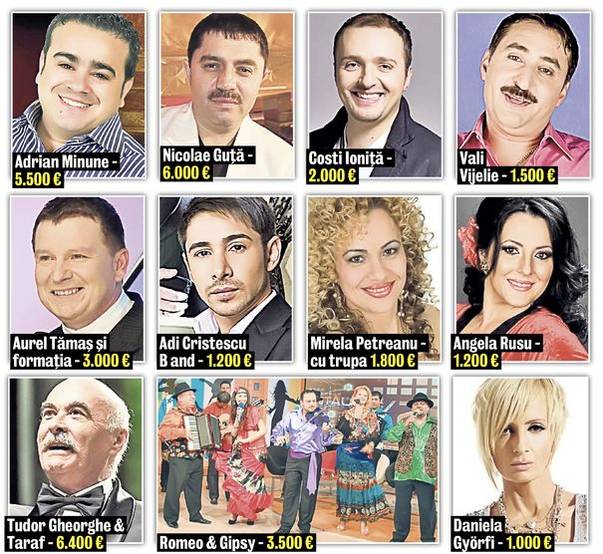
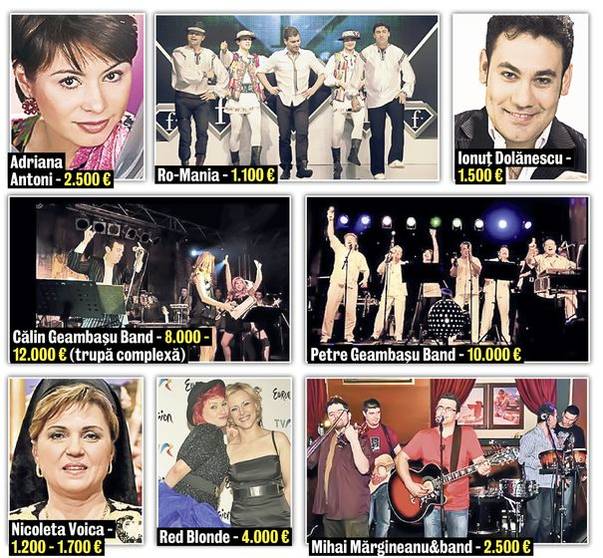
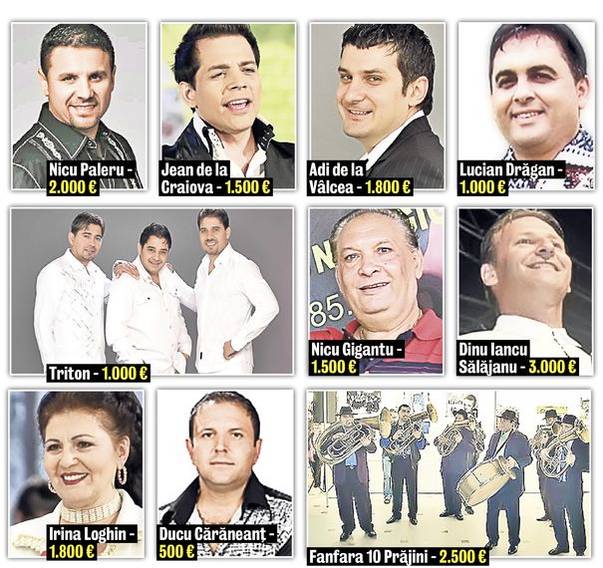
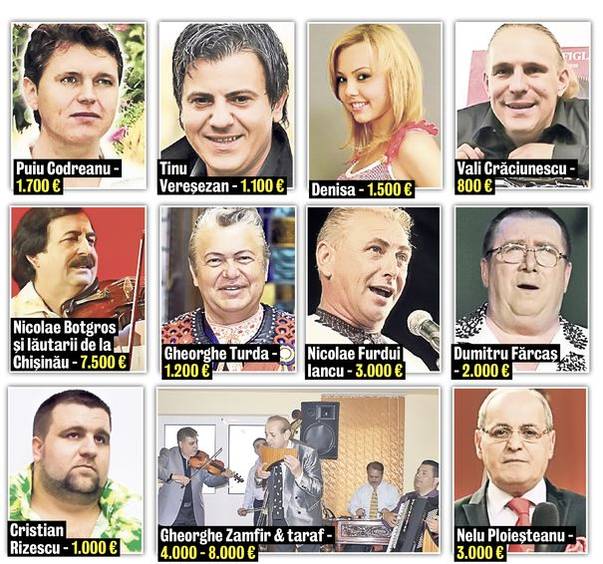
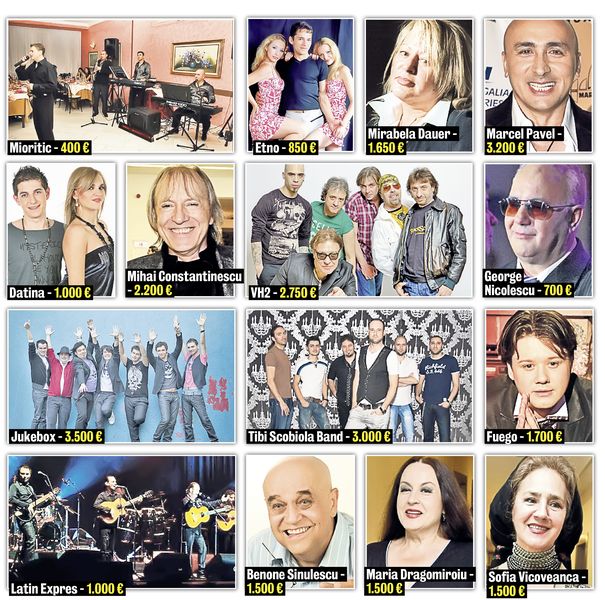
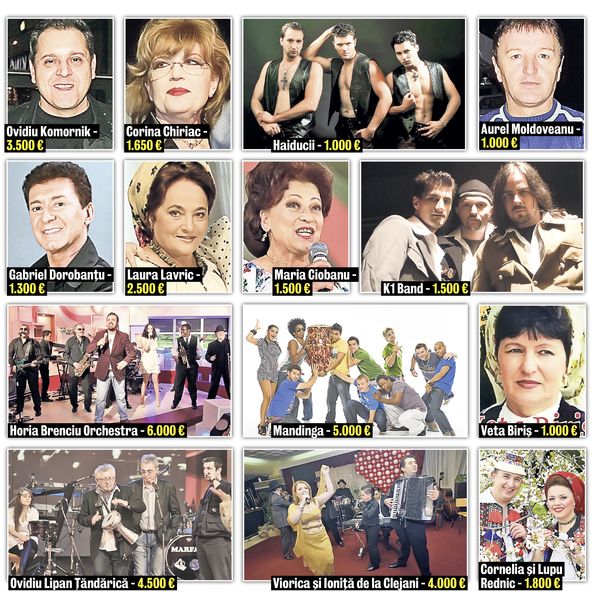
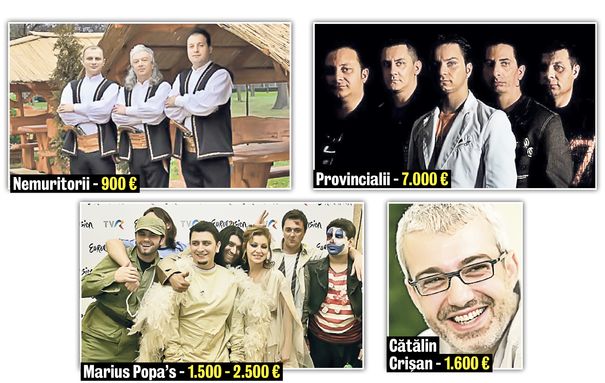
Tarifele practicate de artistii / muzicienii romani (pentru nunta)

Daca iti faci nunta vara aceasta si inca nu ai ales formatia care sa iti incante invitatii, iata cateva idei. Vezi mai jos cat cer trupele sau cantaretii pentru un recital la astfel de petreceri. Preturile, care incep de la cateva sute si ajung la 8.000 de euro, nu includ insa costurile de transport, cazarea si masa.

Acestea se discuta separat, inainte de a bate palma. in plus, tarifele pot creste, daca artistii vin cu aparatura de sonorizare de acasa.

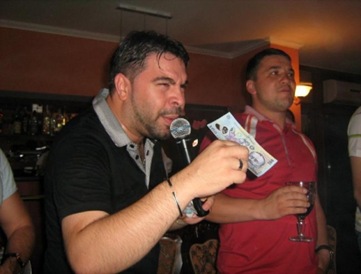
Florin Salam este unul dintre lautarii care percep cele mai mari tarife. Pentru un recital al manelistului trebuie sa scoateti din buzunar o mica avere – 8.000 €.

sursa: www.opiniatimisoarei.ro